Turn AI coding agent work into shipped software.
Superfactory is an agent-neutral orchestration and control plane for AI software development. It coordinates tasks, agents, worktrees, sandboxes, stacked PRs, and reviews so teams can plan epics, run agents in parallel, and ship across every repo and workspace without losing control.
Built for teams already running coding agents. Works with the agents, repos, and CI you already use.
Runs the agents you already use
Agents made coding faster. Coordinating them didn't keep up.
Teams already running coding agents are hitting coordination limits. They don't need another agent — they need a system of record and a review path for agent-produced software work.
More agents than you can coordinate
You're running Claude, Codex, Cursor Agent, and others across tickets, repos, and workspaces — with no shared system of record for the work they produce.
One opaque agent session
Dependent changes collapse into a single hard-to-review diff. There's no clean way to keep agent work reviewable as it stacks up.
No evidence, no recoverability
You can't see what ran, what changed, or where a run became risky — so review, ownership, and recovery before merge are guesswork.
From epic to reviewed PRs.
Superfactory connects planning, parallel agent execution, dependency handling, review, and merge readiness into one loop — the signature workflow that proves agent work can become shipped software.
Plan the epic
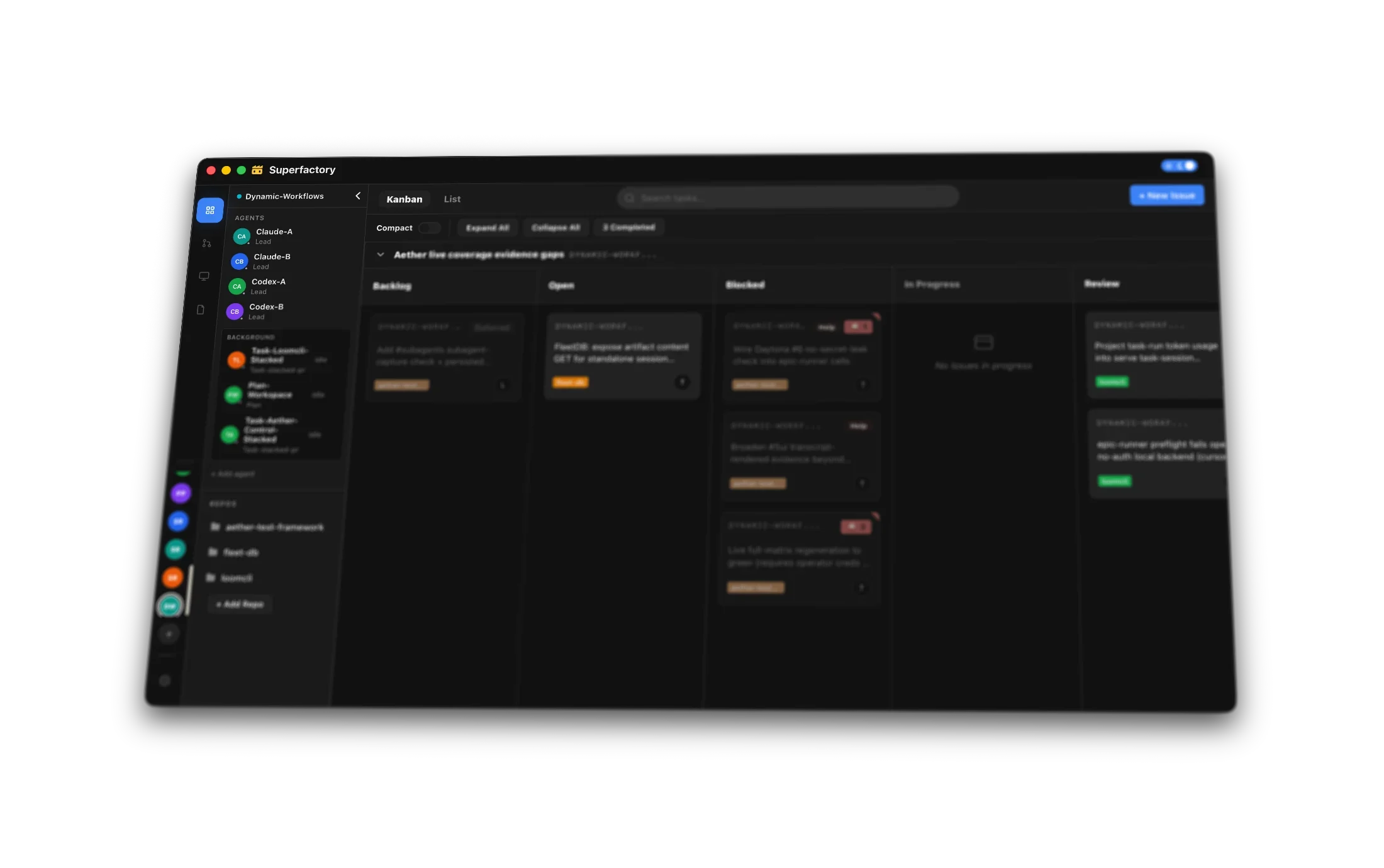
Create an epic with implementation tasks, bugs, and dependencies on the built-in board.
Assign the work
Route tasks to built-in agents or automated workflows — by hand or with the planner.
Run agents in parallel
Agents run in separate worktrees and sandboxes, across repos and workspaces, with full visibility.
Stack the PRs
Dependent changes become reviewable stacked PRs instead of one large, opaque diff.
Review the evidence
Review every change with the ticket, diff, run logs, context, and agent feedback in one decision-ready view.
Ship & track
Merge with humans in control, then track productivity, blockers, and shipped output across repos.
Plan, run, review, improve.
Superfactory organizes the entire feature set into one operating model — turning AI coding agents into a coordinated software production system, with humans in control at every step.
The source of truth for AI-assigned work
A built-in Kanban board with epics, tasks, and bugs, an auto planner and task-runner agent, and chat with any epic or task — so Superfactory isn't just a place to watch external runs.
Real parallel production work
Epic Runner, task agents, and automated workflows execute in separate worktrees and supported sandboxes — across repos and workspaces, not single-agent IDE sessions.
Reviewable change sets with human control
Stacked PRs and a PR page link tickets, diffs, logs, and agent review output. A PR Review Agent and Auto Bug Agent keep agent output reviewable before it merges.
The long-term loop from shipped work
Productivity tracking, codebase understanding, large refactors, readiness evaluation, monitoring, and auto-updated docs turn shipped work and failures back into better planning.
Production roles, not generic chatbots.
Superfactory ships with agents that play specific roles in the production loop — and you can extend the system with your own automated workflows.
Turns an epic into stacked PRs
Drives a whole epic through its tasks — running agents across worktrees and sandboxes and producing dependent, reviewable PRs instead of one giant change.
Reviews every change in context
Reads the linked ticket, diff, and run evidence, then leaves structured review output on the PR page so humans approve with full context.
Fixes bugs and follow-up work
Picks up bugs and follow-up work from inside the same production flow, then prepares each fix as a reviewable PR.
Plans the work and keeps it moving
Breaks epics into tasks, bugs, and dependencies, assigns them to agents or automated workflows, and keeps the board flowing.
Coding agents write code. Superfactory runs the factory around them.
Superfactory isn't another coding agent. It's the production system that coordinates work across agents, repos, tickets, and PRs — so you run the best agent for each job while the factory keeps everything reviewable and shipped.
- Not another coding agent — Superfactory coordinates agents from multiple backends
- Not another IDE — it owns the production workflow across tickets, repos, workspaces, sandboxes, and reviews
- Not just a Kanban board — tasks become agent runs, stacked PRs, review loops, and measurable shipped output
- Not just observability — visibility is the trust layer inside a broader production system
Toward a self-improving SDLC.
Superfactory learns from every run, review, bug, and failure so software production gets more reliable over time. Agents fail silently today — next, those failures become traceable, searchable, fixable, and useful for future planning.
Clear answers
Superfactory, in plain terms
Direct answers about the product, the operating model, and the first design-partner workflow.
- What is Superfactory?
- Superfactory is an agent-neutral orchestration and control plane for AI software development. It coordinates tasks, coding agents, worktrees, sandboxes, pull requests, and reviews across the software delivery lifecycle.
- Who is Superfactory for?
- Superfactory is built for engineering leaders and platform teams operating multiple AI coding agents who need one reviewable system of record for agent runs, artifacts, pull requests, costs, and accepted outcomes.
- Does Superfactory replace coding agents or IDEs?
- No. Superfactory sits above coding agents, IDEs, issue trackers, Git hosts, and CI systems. Teams can keep their preferred tools while Superfactory coordinates the work around them.
- How does Superfactory improve over time?
- Superfactory captures the evidence and review state from each run, then uses accepted outcomes as feedback for future work. The long-term goal is a self-improving software factory with human control at every important decision.
- What is the initial Superfactory pilot?
- The design-partner pilot focuses on ticket-to-agent-to-pull-request traceability: turning an engineering task into reviewable agent work and a production-ready pull request with full run visibility.
See an epic ship end to end.
Request access to run your first epic, plan the tasks, run agents in parallel, stack the PRs, and review every change across your repos with humans in control.
- Stacked, reviewable PRs
- Linked task + run evidence
- Parallel multi-repo agents
- Humans in control before merge